Amazon EventBridge Launches Enhanced Custom Event Bus to Streamline Multi-Account Serverless Architectures

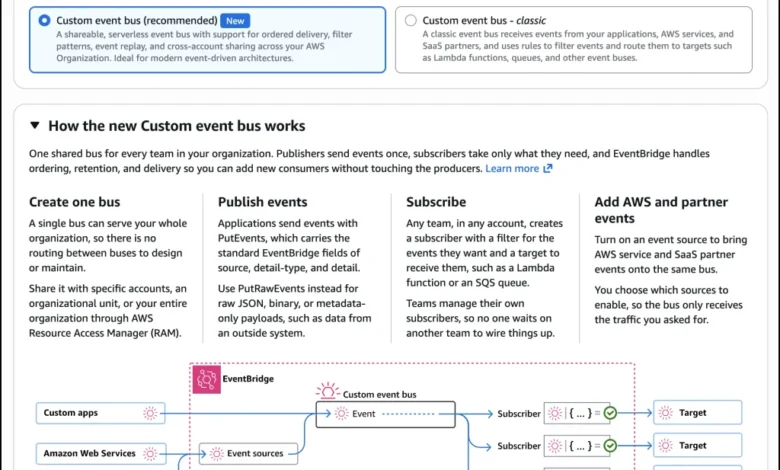
The evolution of cloud-native development has reached a significant milestone as Amazon Web Services (AWS) introduces an enhanced custom event bus for Amazon EventBridge. This new architecture is designed to address the growing operational friction faced by organizations operating complex, event-driven systems across multiple AWS accounts. By shifting from a fragmented, multi-bus model to a centralized, shared-bus architecture, AWS aims to resolve long-standing challenges regarding visibility, event ordering, and the compounding costs associated with cross-account event routing.
The Evolution of Event-Driven Complexity
Since the inception of serverless computing, event-driven architecture has been the gold standard for decoupling microservices. In an ideal scenario, an application is composed of small, independent functions that react to events, allowing for rapid iteration and scalability. However, as organizations scale, the "single account" model—where all resources reside within one AWS environment—becomes insufficient. Corporate security policies and governance mandates often necessitate a multi-account strategy, where different teams manage distinct environments to minimize blast radiuses and enforce strict permission boundaries.
Previously, scaling these architectures meant creating a web of interconnected event buses. Developers were forced to configure cross-account rules or bus-to-bus routing, creating a maintenance burden that often negated the agility benefits of serverless technology. Platform engineers frequently struggled with "spaghetti architectures," where tracing the lineage of an event across multiple accounts became an exercise in forensic engineering. Furthermore, the operational cost of these workarounds often ballooned, as each hop in the routing process incurred additional charges, leading to unpredictable billing patterns for large-scale enterprises.

Chronology of EventBridge Innovation
The introduction of the enhanced custom event bus is the culmination of years of iterative development on the EventBridge platform. Since its transition from the original CloudWatch Events, EventBridge has undergone several major upgrades:
- 2019: AWS officially launched Amazon EventBridge as a serverless event bus, simplifying the integration of SaaS applications with AWS services.
- 2020-2022: The service expanded to include features such as schema registries, archive and replay capabilities, and advanced filtering patterns.
- 2023-2025: As enterprise adoption grew, the limitations of the classic bus architecture—specifically regarding cross-account visibility and strict ordering—became a primary focus for the AWS serverless engineering team.
- September 2026: The release of the enhanced custom event bus represents the most significant architectural pivot for the service, moving toward a centralized, shared-resource model.
Technical Architecture and Enhanced Functionality
The core value proposition of the enhanced custom event bus lies in its ability to act as a unified event backbone. By leveraging AWS Resource Access Manager (AWS RAM), platform teams can now provision a single bus that is shared across the entire AWS organization. This removes the manual overhead of managing individual resource policies for every cross-account connection.
Solving for Event Ordering
One of the most persistent hurdles in distributed systems has been the requirement for ordered event processing. While many cloud-native applications are designed to be asynchronous and order-agnostic, specific domains—such as logistics, financial transactions, and state-machine workflows—require strict sequential execution. The new enhanced bus introduces an EventGroupId mechanism. When events are tagged with this identifier, EventBridge guarantees that they are delivered in the order they were received.
This capability is further bolstered by synchronous invocation support for targets such as AWS Lambda. In legacy configurations, developers often had to place an Amazon SQS queue between the bus and the target function to ensure reliability and order. The new architecture allows for direct, reliable delivery, effectively flattening the stack and reducing latency.

Streamlined Subscriber Management
The introduction of the "Subscriber" resource represents a paradigm shift in how consumers interface with the bus. Previously, developers had to manage a collection of rules, targets, and retry policies as separate, disparate entities. The Subscriber resource consolidates these configurations into a single management unit. This unified approach provides:
- Enhanced Filtering: Fine-grained control over which events are consumed, reducing unnecessary compute cycles.
- Variable Start Times: The ability to onboard new consumers with precise control over when they begin processing event streams.
- Simplified Error Handling: Consolidated retry policies and dead-letter queue (DLQ) settings per subscriber, rather than per rule.
Economic Implications and Cost Structure
The transition to a new pricing model is arguably as impactful as the technical updates. The previous per-event cost structure, when applied to multi-bus, cross-account configurations, often led to "hidden" costs as data traversed multiple hops. The enhanced event bus shifts to a throughput-based model: publishers pay for ingestion, and subscribers pay for delivery.
This model provides greater cost predictability for finance and DevOps teams. By eliminating the compounding fees associated with intermediate bus routing, organizations can more accurately forecast expenditures based on actual data volume rather than architectural complexity. For large enterprises, this represents a significant shift toward cost-optimization, aligning infrastructure spending with actual business utility.
Industry Impact and Market Reception
Industry analysts suggest that this update addresses the "scaling wall" that many organizations hit after migrating their core workloads to AWS. "The shift from managing hundreds of individual buses to a single, governed backbone is a maturation point for serverless architectures," noted a lead cloud architect at a major financial services firm. "The ability to enforce consistent ordering and governance at the infrastructure level, rather than the application level, reduces the cognitive load on development teams."
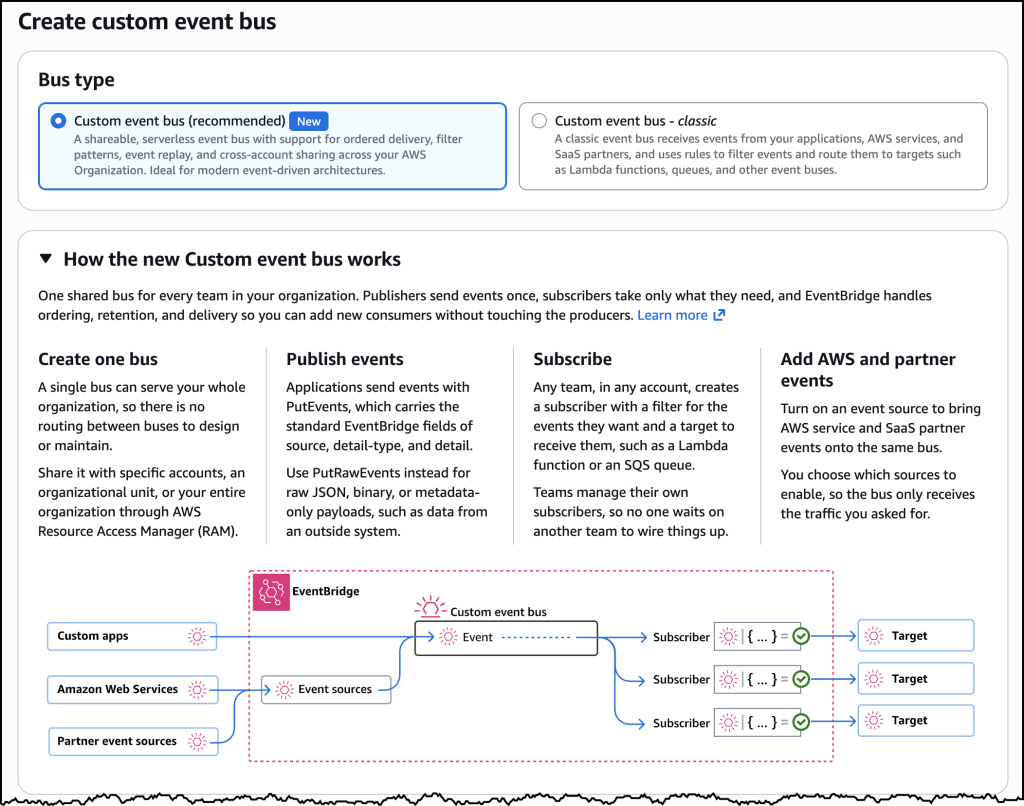
The inclusion of features like JSONata expression support for event transformation and native deserialization of Apache Avro and Protocol Buffers further highlights AWS’s commitment to supporting complex, schema-heavy enterprise environments. By allowing subscribers to reshape data before it reaches a target, EventBridge is positioning itself as a more intelligent integration layer rather than a simple message transport service.
Future Outlook and Implementation
The enhanced custom event bus is currently available in multiple global regions, including US East, US West, and several key hubs in Europe and Asia Pacific. While the "classic" bus remains available for legacy workloads, the push toward the enhanced model is clear. AWS is encouraging organizations to evaluate their existing event-driven topology to determine where consolidation can provide immediate performance and cost benefits.
For platform teams, the immediate priority will be the migration of high-traffic, multi-account flows to the new architecture. The use of AWS RAM to manage sharing ensures that security teams can retain control over resource access, while developers gain the agility to publish and subscribe without constant interaction with central IT for infrastructure provisioning. As organizations continue to distribute their applications across global AWS accounts, the enhanced custom event bus serves as a critical tool for maintaining order in an increasingly complex digital ecosystem. By balancing the need for autonomy at the team level with the necessity for governance at the enterprise level, AWS has provided a blueprint for the next generation of serverless integration.